GET YOUR ALL ACCESS PASS!
Enter your payment details below to continue
Order
Items
Summary

FOR GUITARISTS WHO KNOW THE LICKS… BUT CAN’T MAKE THEM FLOW
Turn The Random Licks You Already Know Into Solos That Flow...
In 60 Days or Less
Discover how to use the Five Pillars of Phrasing to create solos with a clear beginning, middle and end...
without learning another scale, mode or arpeggio.
Get The Complete Self-Paced Edition of The Art of Guitar Phrasing
One payment gives you immediate lifetime access to all six modules, 36 focused exercises, guided practice workouts and every included course resource.
You've Played For Years And Know Your Scales...
So Why Do Your Solos Still Sound Awkward And Disconnected?
You know the pentatonic shapes.
You’ve memorised plenty of licks - and you may even understand some music theory.
But when the backing track starts and it’s time to create something of your own…
You fall back on the same bad habits and disconnected licks you’ve played a thousand times.
There’s no clear beginning, development or satisfying ending.
You start noodling, the backing track runs its course and eventually... you simply stop.
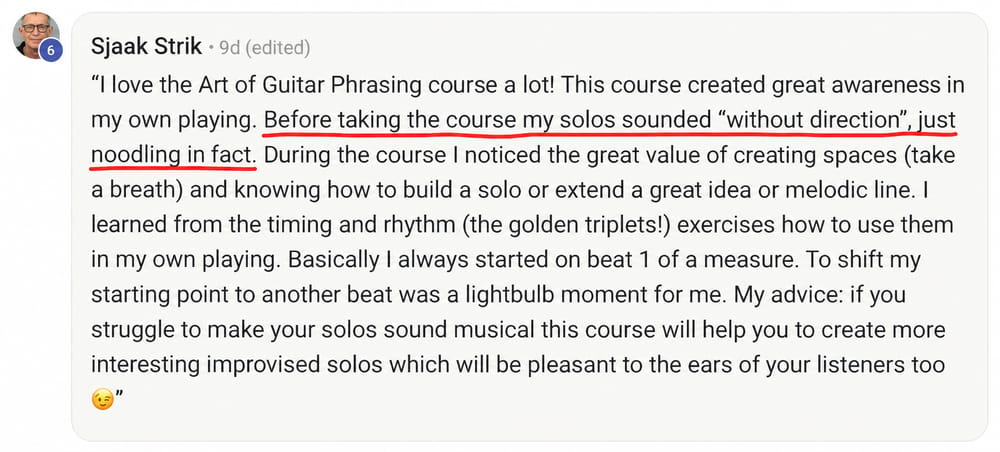
Learning More Guitar 'Tools' Won't Fix A Lack of Phrasing Frameworks
So you search for another lick, scale or “secret” concept that promises to unlock the fretboard.
For a few days, it feels like progress.
But when you improvise, the same habits return: predictable timing, repetitive rhythms, too many notes and no idea how to develop a phrase.
Your 'knowledge' keeps growing - but your solos stay exactly where they were.
You can learn somebody else’s solo.
You just can't seem to write a solo of your own that gives you that same feeling...
Sound Familiar?
These Guitarists Had The Knowledge...
But Couldn’t Turn It Into Music.
Most Lead-Guitar Courses Teach You What Notes You Can Play.
This Course Teaches You How to Say Something With Them.
The difference between a random collection of licks and a solo that sounds musical is rarely another scale.
It is the decisions you make with the notes already under your fingers:
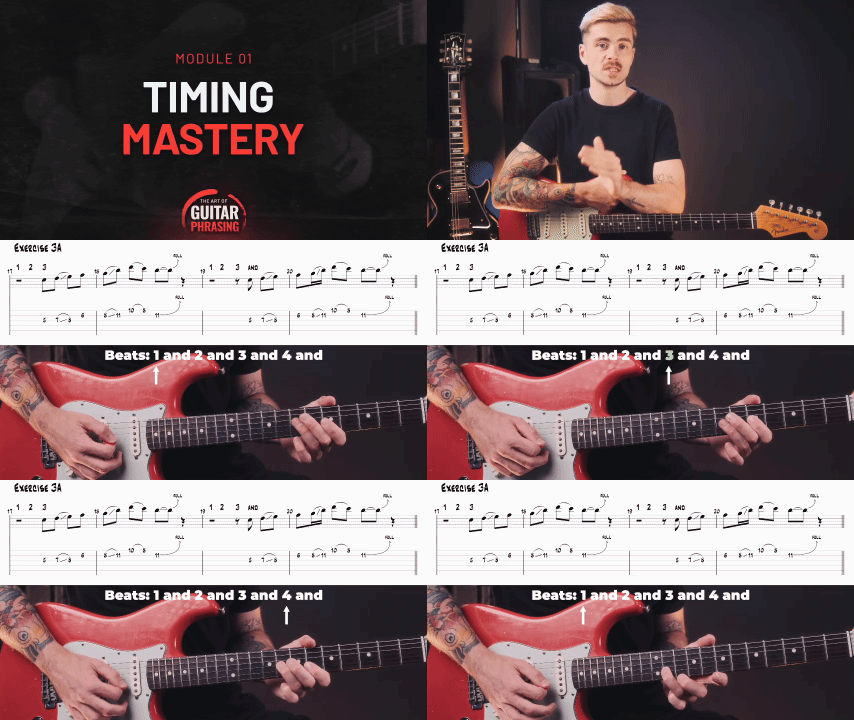
Timing
When does each phrase begin - and how can starting on different beats and offbeats make the same notes sound completely different?
Rhythm
How do the notes move - and how can mixing straight and triplet rhythms create more variety and interest?
Repetition
How can you repeat, answer and develop a simple musical idea...
...instead of abandoning it for another unrelated lick?
Space
When should you stop playing, leave breathing room and give each phrase the chance to land with greater impact?
Structure
How do you connect your ideas and organise them into a complete solo with a clear beginning, development and satisfying ending?
Together, These Five Pillars Turn Disconnected Licks Into Solos That Flow.
Instead of constantly searching for the next lick, you’ll know how to begin an idea, develop it and bring your solo to a satisfying conclusion.
What Changed When They Stopped Learning More Tools...
...and Started Saying Something With What They Already Knew
Imagine Knowing How To Make Your Solo Go Somewhere
Imagine starting a solo with one clear musical idea instead of grabbing the first lick your fingers can find.
You vary its timing and rhythm, develop it through repetition and leave space that makes every phrase hit harder.
Instead of jumping between disconnected licks, you create a solo with a clear beginning, development and satisfying ending.
You’re no longer hoping something musical magically falls out of the scale.
You’re making intentional choices with confidence.
And you don’t need more theory, scales or fretboard shapes to do it...
You can create that transformation using the pentatonic shapes and licks already under your fingers.
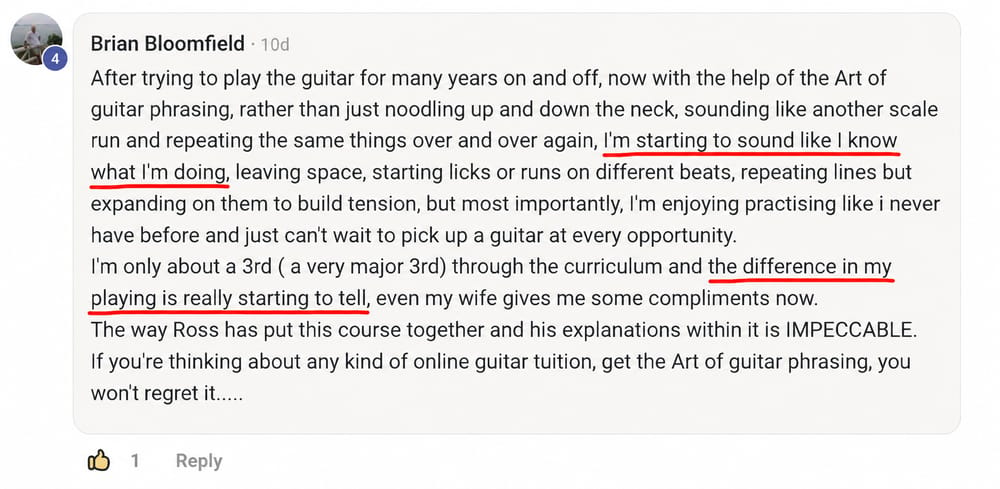
Don't just take my word for it...
Hear What Happens When Guitarists Stop Collecting Scales
And Start Practicing Phrasing
From “Meandering” To A Solo With Direction In 37 Days
“I found it remarkable how a few critical adjustments could make such a difference.” — Rob
Rob already understood scales and triads.
His challenge was applying that knowledge to create something that sounded like music rather than another exercise.
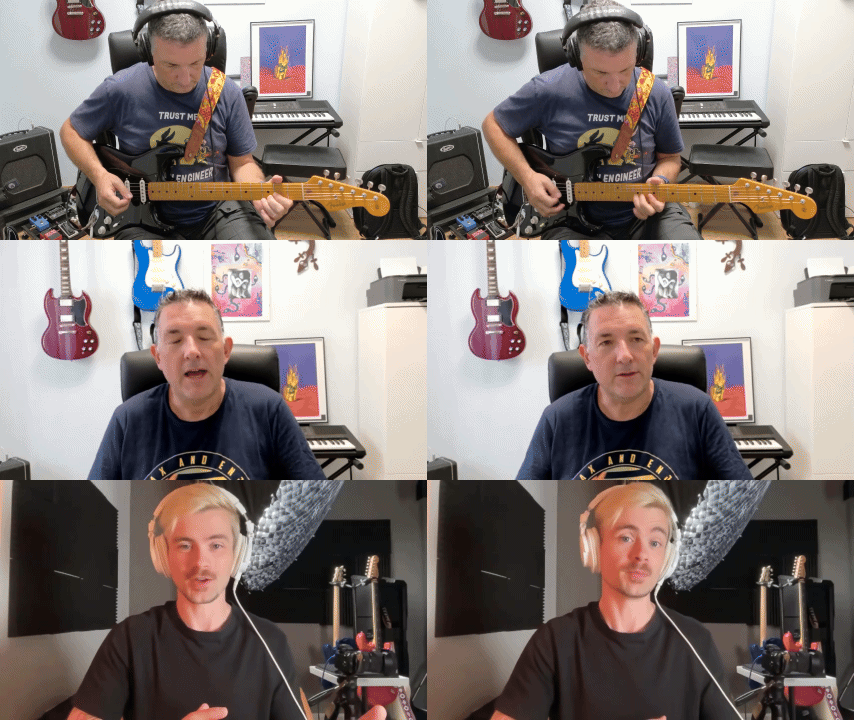
Listen to the difference between his original solo and the solo he recorded 37 days later after working on timing, rhythm, repetition, space and structure.
From Predictable Licks To Rhythmic Variety In 33 Days
“How quickly I was able to progress by focusing on one set of material was probably the biggest surprise.” - Shaun
Shaun had studied pentatonics, modes, CAGED shapes and triads, all in the hopes of fixing his soloing.
His breakthrough came from realising that simple pentatonic material was already enough when combined with timing and rhythmic variation.
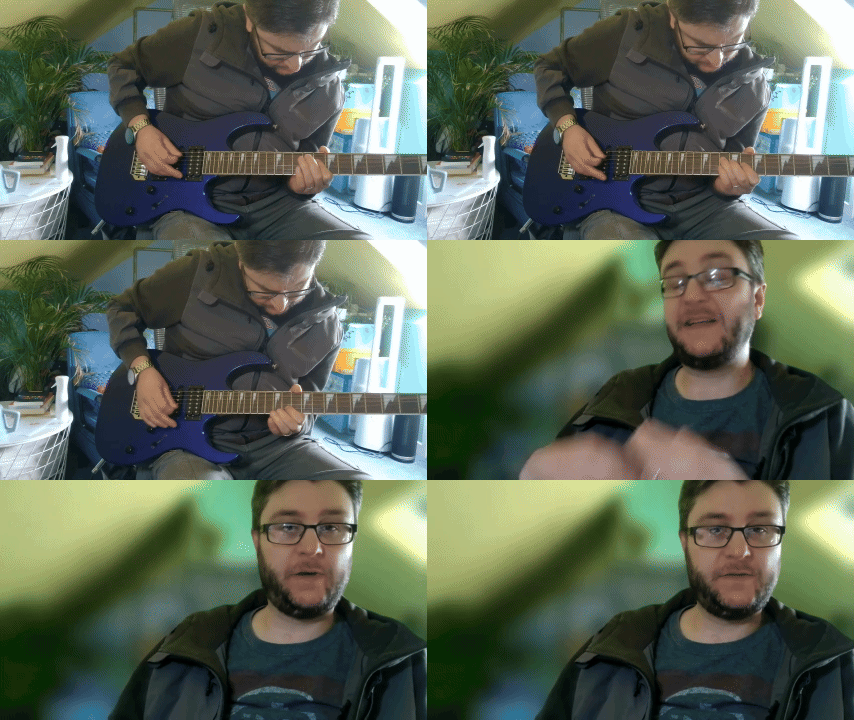
From Directionless To A Structured Solo In 33 Days
“It doesn't sound like me… It's so different from how I'm used to hearing myself play.” — Chris
Before taking the course, Chris described his soloing as “directionless” and had never connected his ideas into one cohesive solo.
In just 33 days, he used repetition, space and structure to create a solo that sounded so different, he barely recognised it as his own.
How John Learned To Repeat An Idea Without Sounding Repetitive In 48 Days
“It had so much more structure than what I would normally do.” — John
Before taking the course, John described his soloing as familiar pentatonic licks strung together without much thought given to timing or structure.
He learned to use rhythmic subdivisions, motifs and repetition to connect those ideas - and create one cohesive solo with an intentional ending.
From Practicing In His Car To Soloing With Confidence In 41 Days
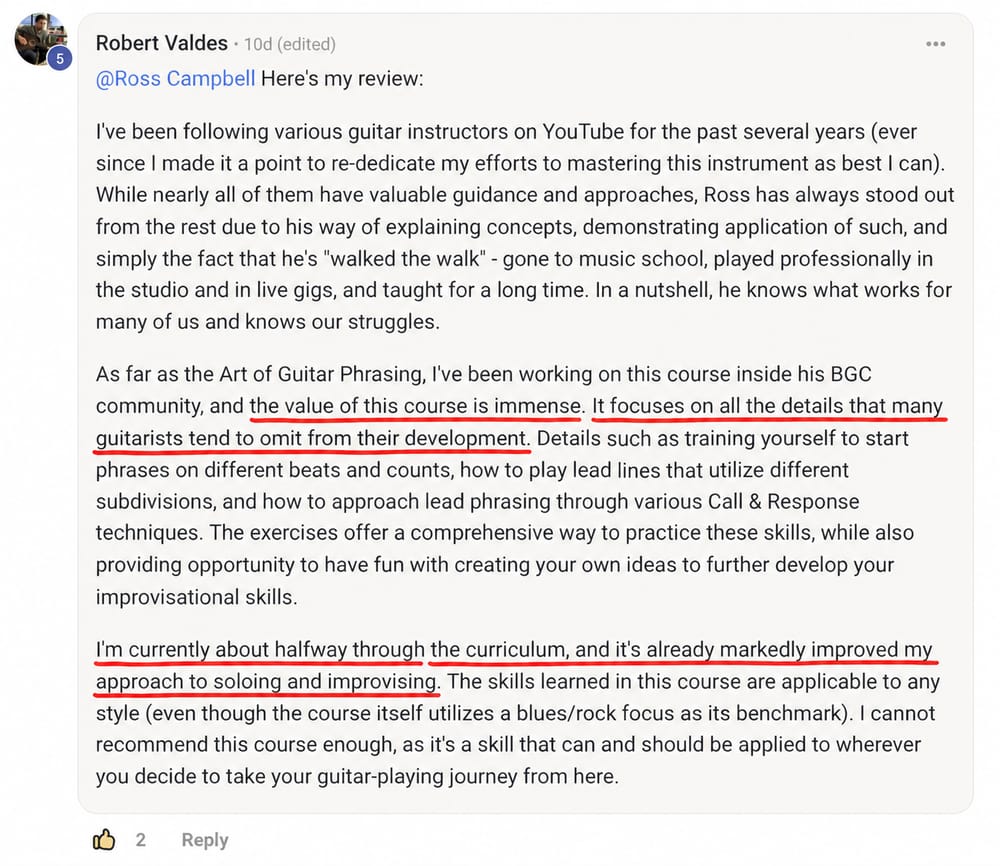
“A year ago, I wouldn’t have been able to incorporate those ideas over a track and feel confident playing them in time.” — Robert
With work and a young family, Robert couldn’t always practice at home - so he brought his guitar to work and practiced phrasing from his car whenever he found the time.
By focusing on timing and rhythm, he learned to connect his ideas over a backing track with far greater confidence - and prove that meaningful progress doesn’t require the perfect practice setup.
How Iain Learned To Tell A Story With His Soloing
“It gives you rhythmic variety, call and response, space for the audience - and a recognisable ending.” — Iain
Iain came into the course as an intermediate player who felt his solos often went on for too long without enough focus or any clear sense of direction.
After six to eight weeks, he began approaching his solos more like complete musical stories.
Instead of simply playing until the backing track stops, Iain now understands how to give his solos shape, direction and a reason for the listener to keep following.
The Result?
Solos With More Confidence, Direction And Musical Intent.
Introducing:
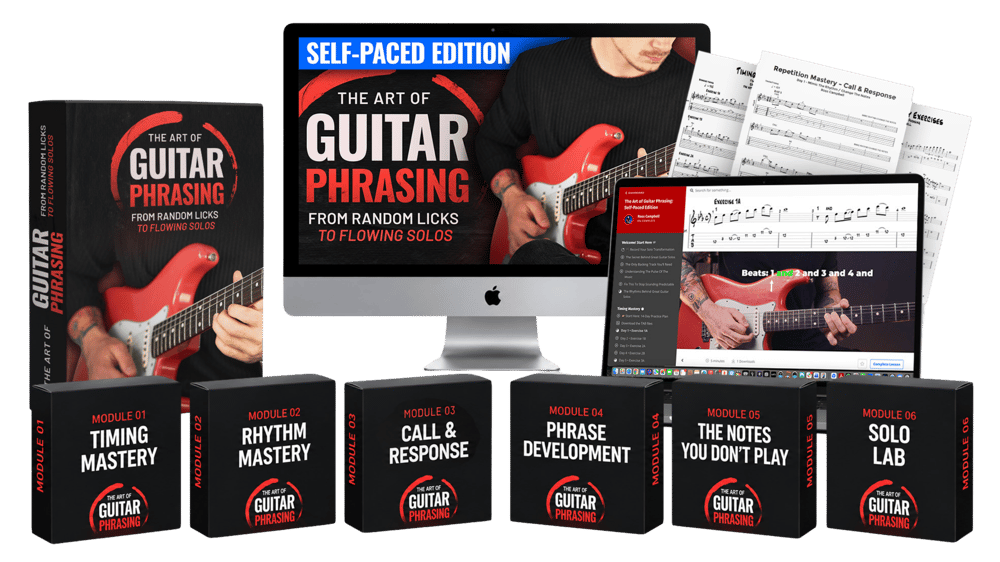
The Art Of Guitar Phrasing: Self-Paced Edition
I originally developed The Art of Guitar Phrasing inside Bulletproof Guitar Club - my private community, where members work through the curriculum alongside the community and receive feedback on their playing.
But I heard from plenty of guitarists who wanted the complete course without joining an ongoing membership—players who were happy to learn independently and work at their own pace.
So I created this standalone self-paced edition.
You receive the complete six-module curriculum for one payment, with lifetime access to every lesson and resource, but without the community or feedback elements of the club.
Follow the recommended eight-week learning path or move through the material entirely at your own pace. Nothing expires, and you can return to the exercises whenever your phrasing needs a reset.
Here's how it works...
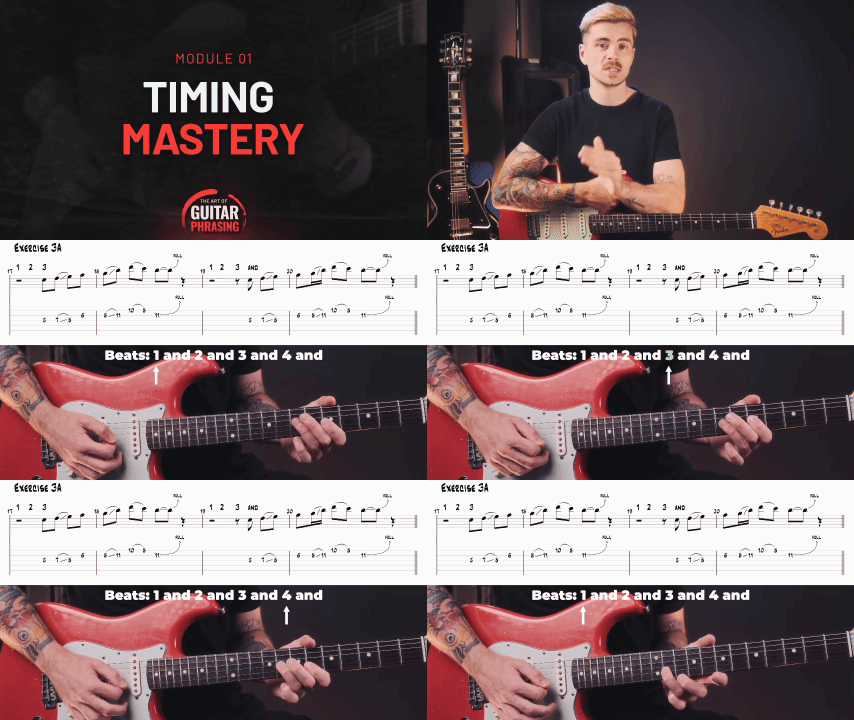
MODULE #1: TIMING MASTERY
WEEKS 1-2
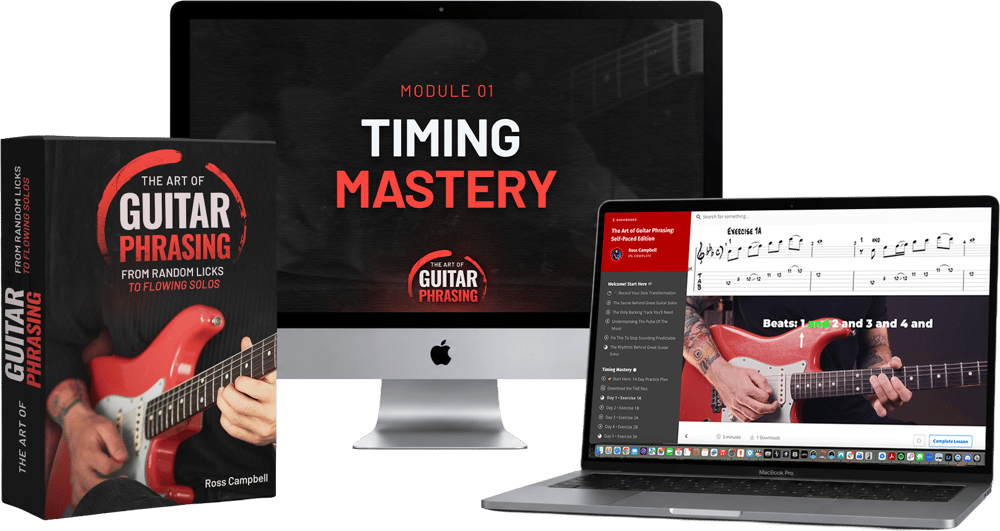
Stop Beginning Every Phrase On Beat One
Most late beginner and intermediate guitarists begin their phrases in the same predictable place without even realising it.
Across eight daily exercises, you will learn phrases beginning on every main beat and offbeat in a bar of 4/4 - then create your own phrases using the same timing constraints.
You will hear how the exact same group of pentatonic notes can feel completely different simply because you begin them later in the bar.
The module culminates in a six-day guided Timing Mastery workout combining all eight starting points.
“To shift my starting point to another beat was a lightbulb moment for me.”
- SJAAK, STUDENT OF THE ART OF GUITAR PHRASING
MODULE #2: RHYTHM MASTERY
WEEKS 3-4
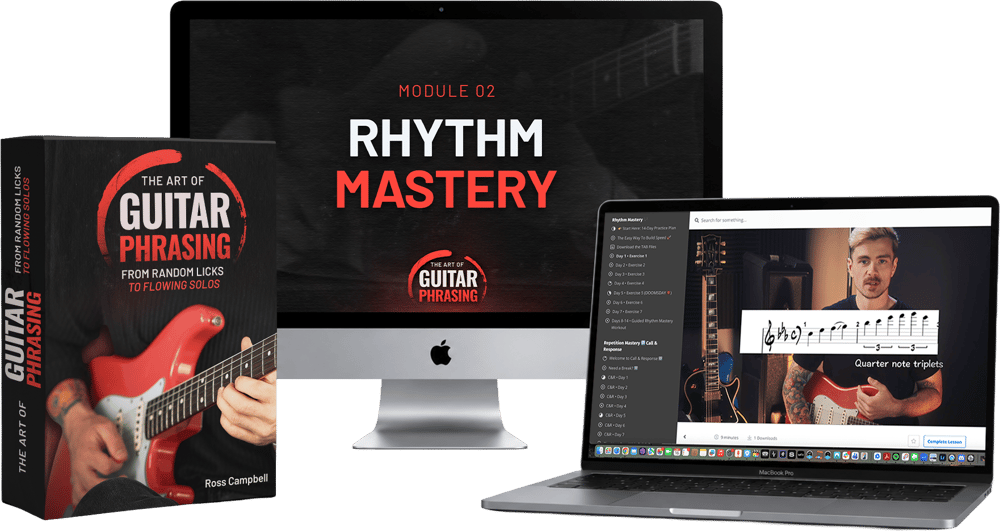
Make Your Solos Groove - Using The Scales You Already Know
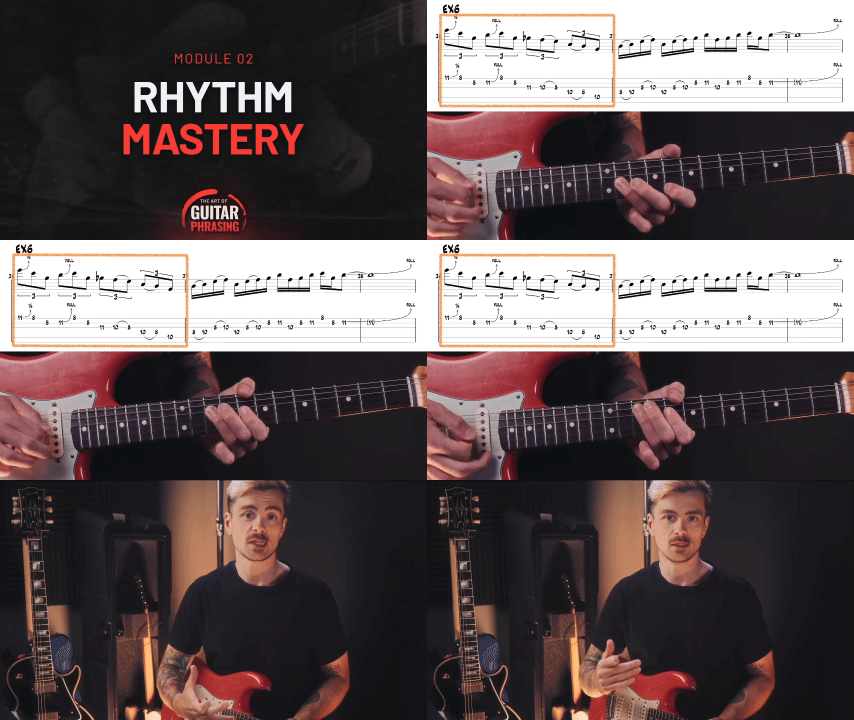
When every line uses the same rhythm's, even the 'right notes' begin to sound flat and repetitive.
Across seven daily exercises, you will explore straight and triplet-feel subdivisions and combine them with the phrase entrances developed in Timing Mastery.
You will then reinforce everything through a seven-day guided Rhythm Mastery workout before recording an optional milestone solo to document your progress.
“Pushing myself on the triplets has probably been the biggest improvement in my playing. That complete change of rhythm - and the variation that comes with it - was just devoid from my playing before.”
- SHAUN, STUDENT OF THE ART OF GUITAR PHRASING
MODULE #3: CALL & RESPONSE
WEEK 5
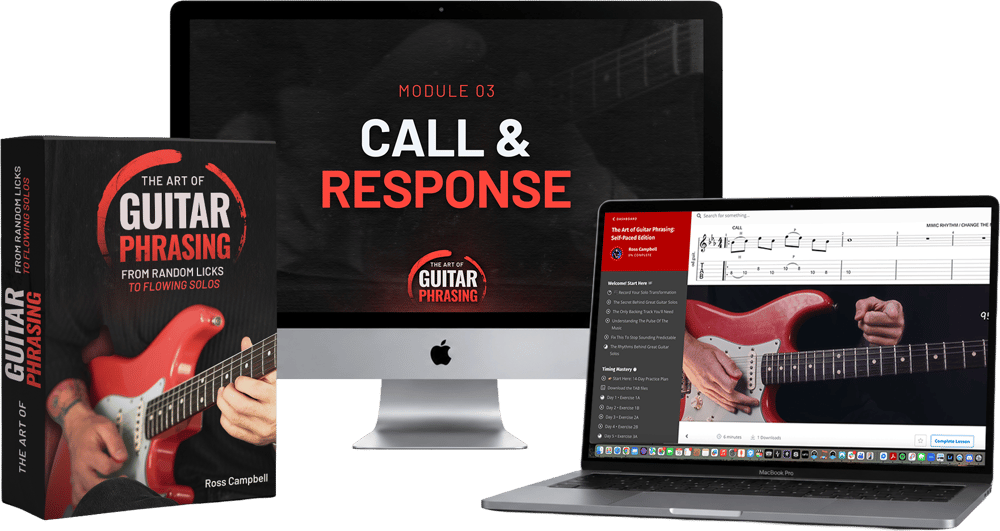
Make Your Phrases Sound Like A Musical Conversation
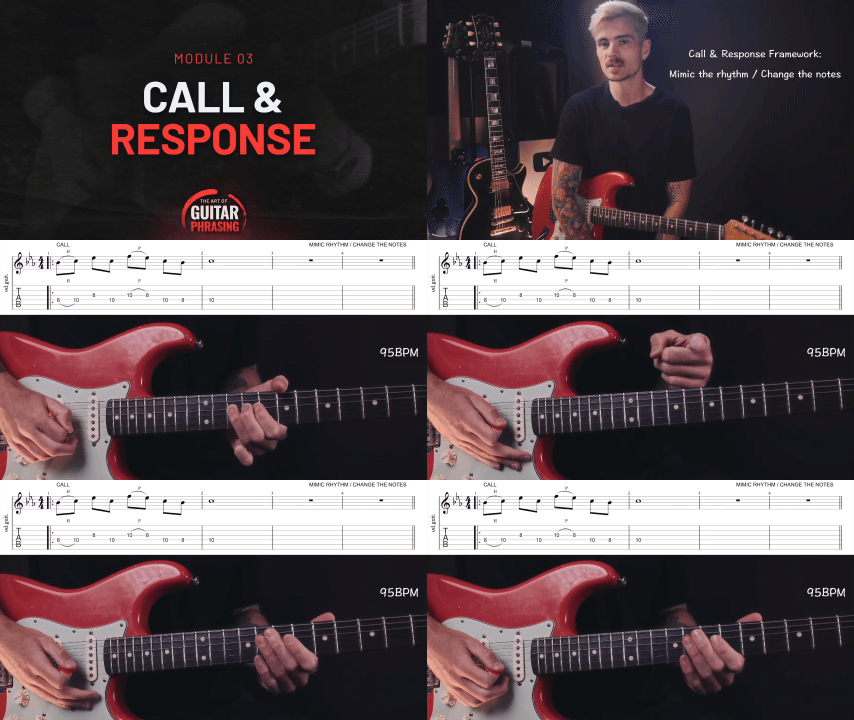
Call and response gives your solo an immediate sense of logic: one short phrase asks a question and the next phrase answers it.
Across seven daily exercises, you will use clear creative constraints to produce appropriate responses - changing the rhythm, copying the rhythm with different notes, moving the idea into another octave and more.
These limitations remove the pressure to invent something new every few seconds. Each phrase begins to have a recognisable relationship with the one before it.
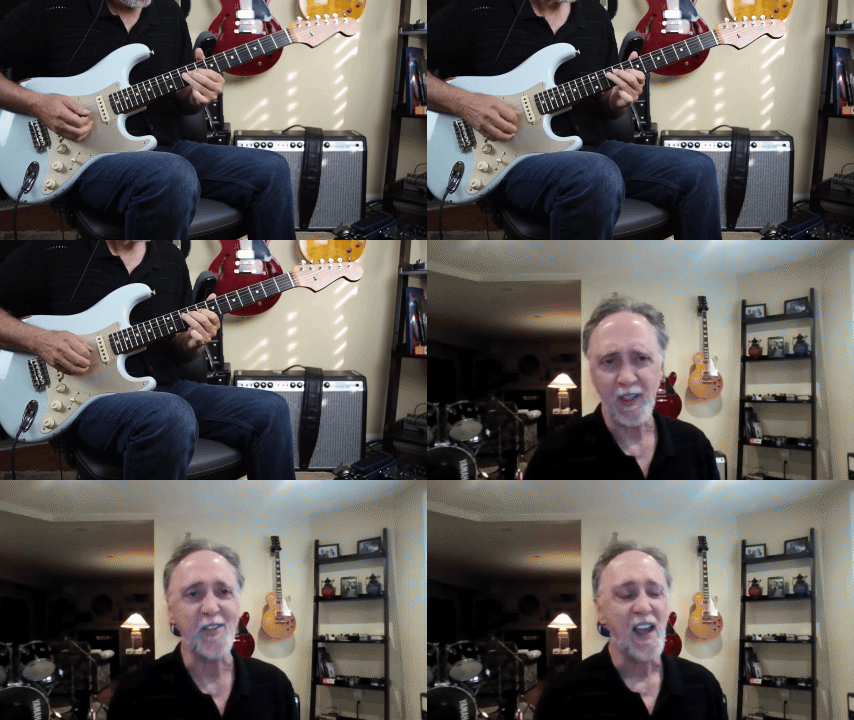
“My solo had so much more structure than what I would normally do.
Using call and response gave me something I could build on.”
- JOHN, STUDENT OF THE ART OF GUITAR PHRASING
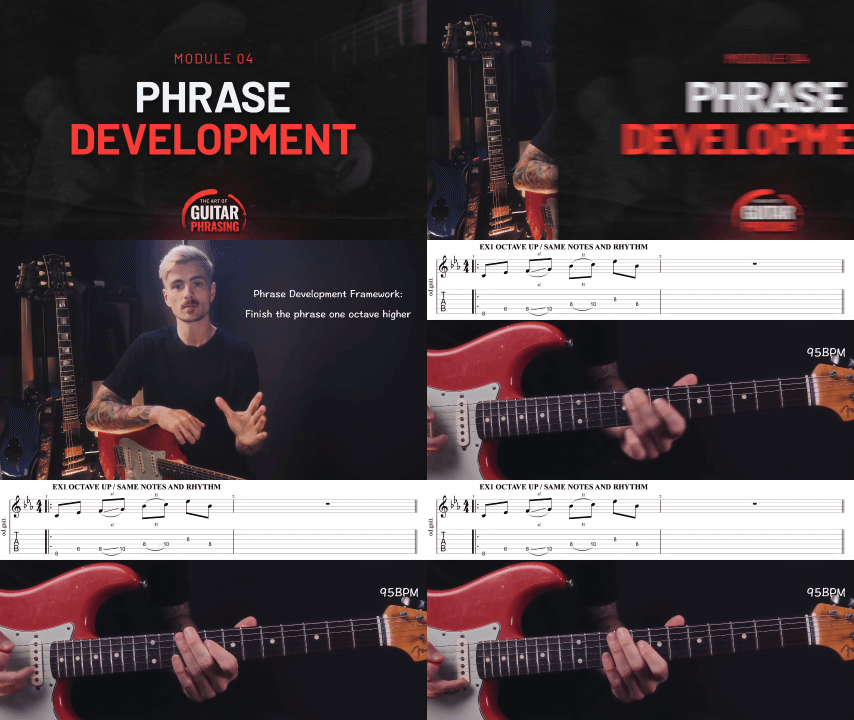
MODULE #4: PHRASE DEVELOPMENT
WEEK 6
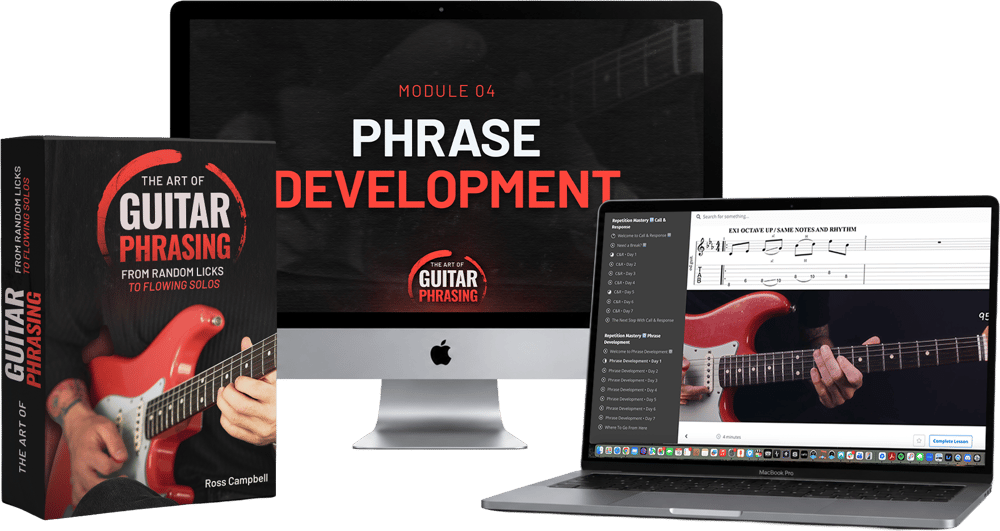
Use Repetition To Build Longer Licks That Flow Across The Fretboard
You do not need dozens of unrelated licks to hold the listener's attention. You need to know how to develop a good idea.
In each of seven daily exercises, Ross provides the beginning of a two-bar phrase.
Your task is to complete it using a specific framework: changing its rhythm, moving it into another octave, adding a new melody or extending the original idea.
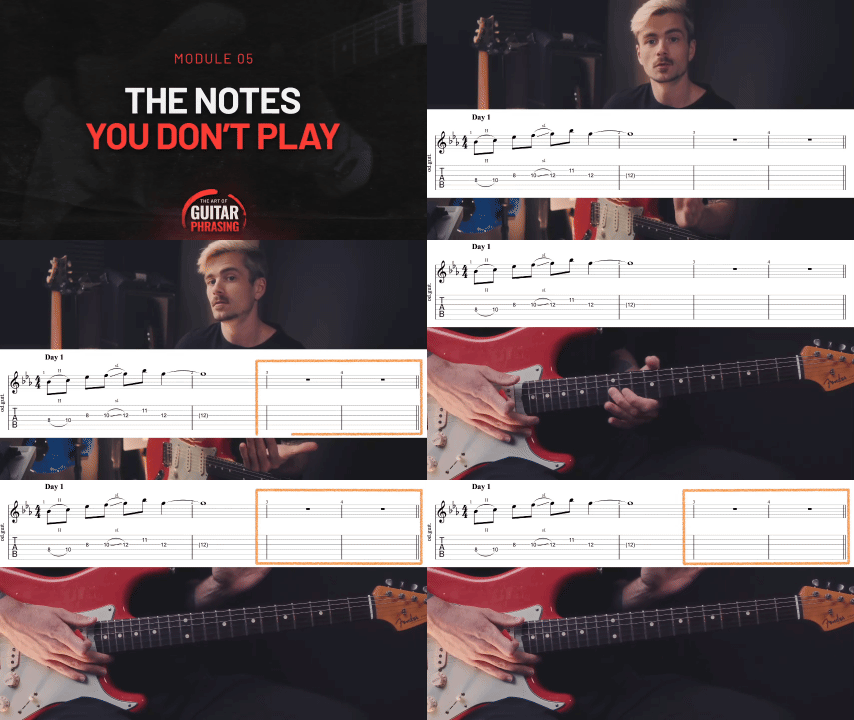
MODULE #5: THE NOTES YOU DON'T PLAY
WEEK 7
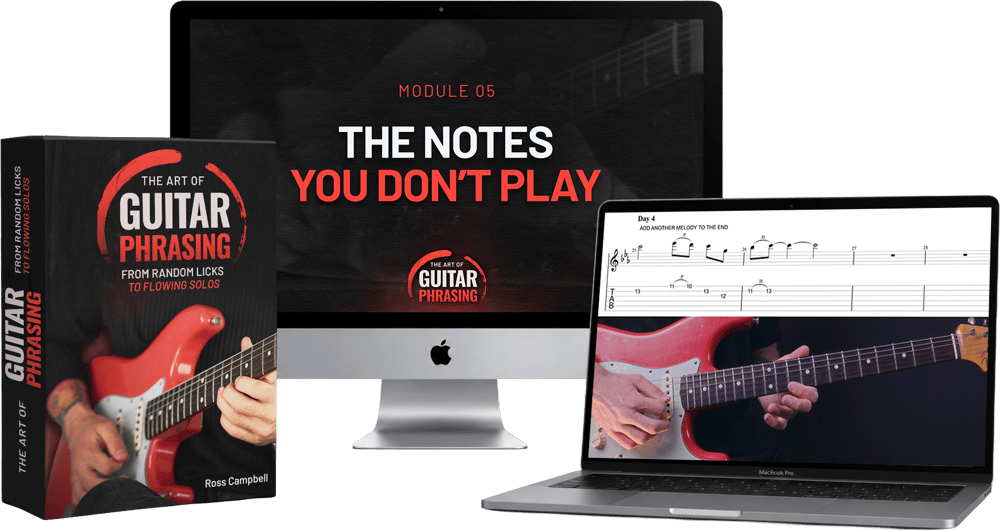
Stop Overplaying And Start Creating Memorable Moments In Your Solo
Many guitarists play lick after lick because silence feels dangerous. But when every gap is filled, no individual phrase receives enough room to become memorable.
This module teaches you to construct the opening 16 bars of a longer solo around one small motif. You will repeat and develop that motif three times while deliberately leaving one or two bars of space after each statement.
Across seven daily exercises, you will discover how much musical mileage can come from one idea - and how space can make you sound more confident, not less capable.
“Playing a lot less gives me more time to think, be more intentional and have a lot more serenity.”
- FRANCESC, STUDENT OF THE ART OF GUITAR PHRASING
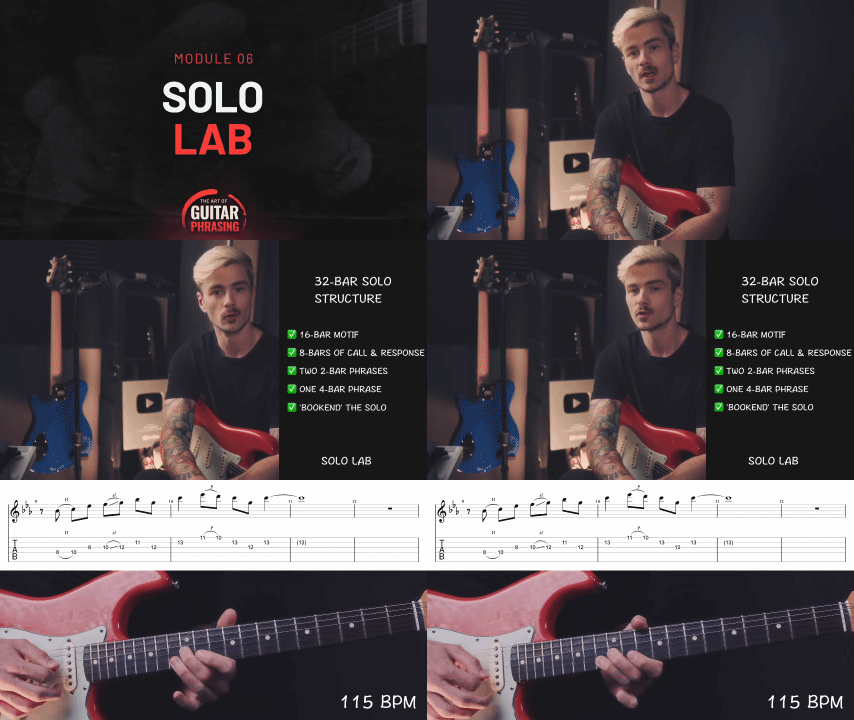
MODULE #6: SOLO LAB
WEEK 8
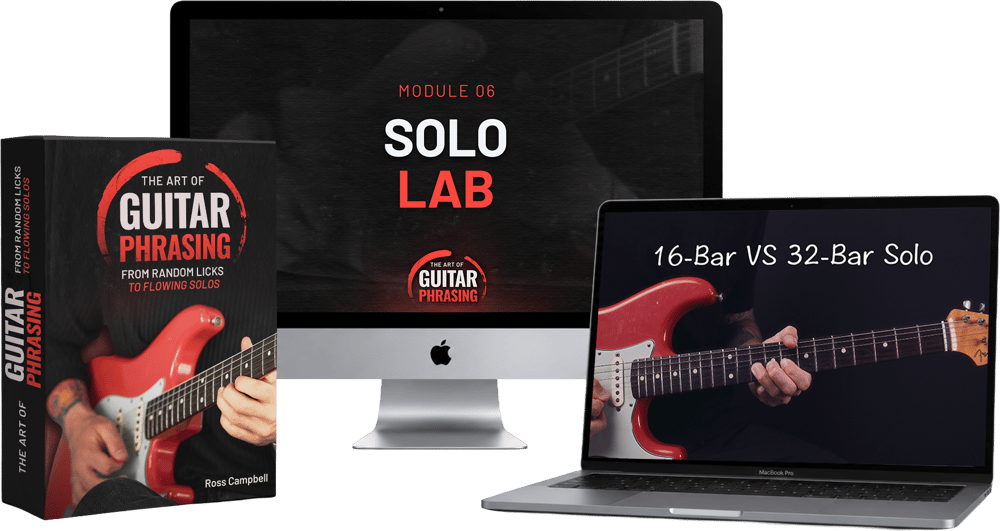
Create Complete Solos That Sound Intentional From Start To Finish
Solo Lab is where timing, rhythm, repetition, space and structure come together.
First, Ross breaks down frameworks for building complete 16-bar and 32-bar solos, including how the length changes the amount of space available and how quickly ideas need to develop.
Next, you enter the Fill-In-The-Blanks solo exercises. Ross has recorded half-complete solos containing empty sections for you to finish.
You will create responses to his calls, develop his opening motifs and complete longer two-bar and four-bar phrases using the skills developed throughout the course.
Finally, you will write and record complete 16-bar and 32-bar solos of your own.
“The biggest thing for me is structure.
My opening solo was basically, ‘Let’s throw stuff at the wall and see what sticks.’
For my milestone solo, I found a few licks that I liked and tried to stitch them together in a cohesive way.”
- CHRIS, STUDENT OF THE ART OF GUITAR PHRASING
HERE'S EVERYTHING YOU GET WHEN YOU INVEST IN YOUR SOLOING PROGRESS TODAY
THE COMPLETE 6-MODULE, 8-WEEK CURRICULUM
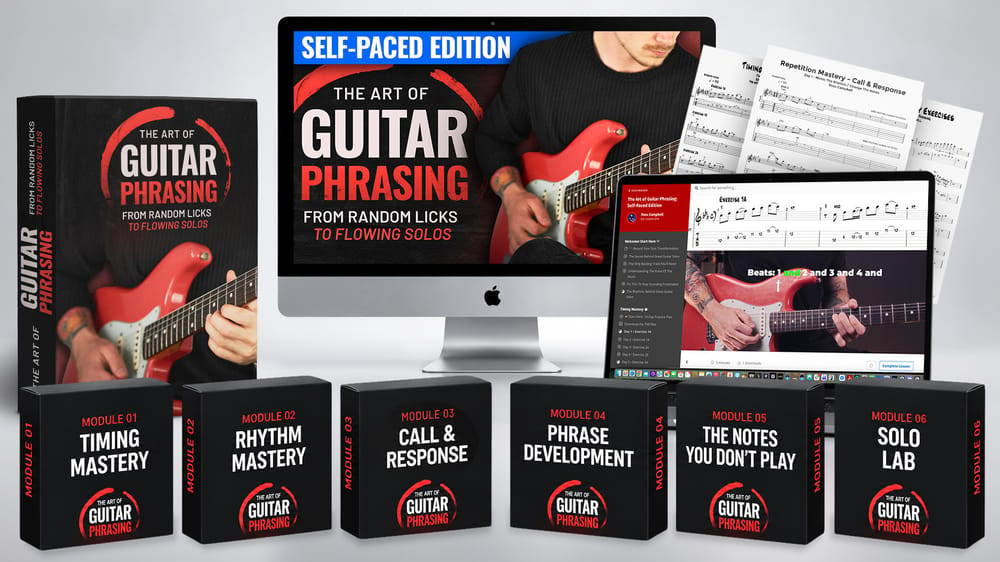
- Six progressive modules
- 6+ hours of downloadable video instruction
- A proven eight-week learning path
- 36 focused exercises across the first five modules
- A guided six-day Timing Mastery workout
- A guided seven-day Rhythm Mastery workout
- 16-bar and 32-bar Fill-In-The-Blanks Solo Lab exercises
THE PHRASING PRACTICE TOOLKIT
- All Along The Watchtower backing track in 3 tempos… so you can practice at your own pace
- Complete Guitar Pro and PDF tablature… so you can learn everything with clarity
- Printable practice sheets… helping you stay focused on each exercise
- Downloadable lesson videos for offline access… so you can learn even when you don't have WiFi
- Vidami Blue compatibility for hands-free playback control
A Clear Path - To Move Through At Your Own Pace
The recommended path takes you through the core curriculum over approximately eight weeks:
WEEKS 1-2
Stop beginning every phrase on beat one by exploring different beats and offbeats, followed by a guided six-day practice workout.
WEEKS 3-4
Create more interesting lines by mixing straight and triplet rhythms, then reinforce everything with a guided seven-day workout.
WEEK 5
Learn to connect short phrases so your solos sound like an intentional musical conversation rather than unrelated licks.
WEEK 6
Use repetition and variation to develop simple ideas into longer, more memorable musical phrases.
WEEK 7
Become comfortable leaving space and learn how to get more mileage from fewer ideas without sounding repetitive.
WEEK 8
Bring everything together using solo-building frameworks and fill-in-the-blank exercises for complete 16-bar and 32-bar solos.
But this is the Self-Paced Edition.
There are no weekly submission deadlines and no pressure to keep up with a group.
Move more slowly if a skill needs extra attention. Repeat the guided workouts. Begin at 70 BPM and increase the tempo when you are ready.
You have lifetime access, so the goal is not to finish quickly. The goal is to make the skills part of your playing.
Sounds Good... But Is This Right For Me?
This course is for you if...
- You know the minor pentatonic scale but your solos still sound random.
- You have learned plenty of licks but struggle to connect them.
- You repeatedly begin phrases in the same place and use the same rhythms.
- You overplay because you are uncomfortable leaving space.
- You can reproduce somebody else's solo but struggle to create one of your own.
- You have spent years collecting guitar and theory knowledge without learning how to apply it musically.
- You want a structured, self-paced path without joining a membership.
This course is not the right fit if...
- You are a complete beginner.
- You have not yet learned a minor pentatonic box or cannot play basic licks.
- You are primarily looking for a library of advanced scales, modes or shred vocabulary.
- You expect fast results without practicing and applying the exercises.
“Will this be too basic if I already know pentatonics?”
The simplicity of the note choices is the point.
The course isolates the phrasing decisions that advanced players make with familiar material.
Students who already knew modes, triads and CAGED shapes discovered that their existing pentatonic vocabulary was enough once they changed how they timed, shaped and connected it.
“Will this only work for blues and classic rock?”
The examples use a blues-rock musical environment, but timing, rhythm, repetition, space and structure are transferable phrasing skills.
Robert specifically described the skills as applicable to any style, even though the course uses blues and rock as its practical foundation.
“What if I cannot play fast?”
Every core exercise is demonstrated at three tempos - 70, 95 and 115 BPM so you can learn accurately and increase the tempo gradually.
Reaching the fastest version immediately is not required.
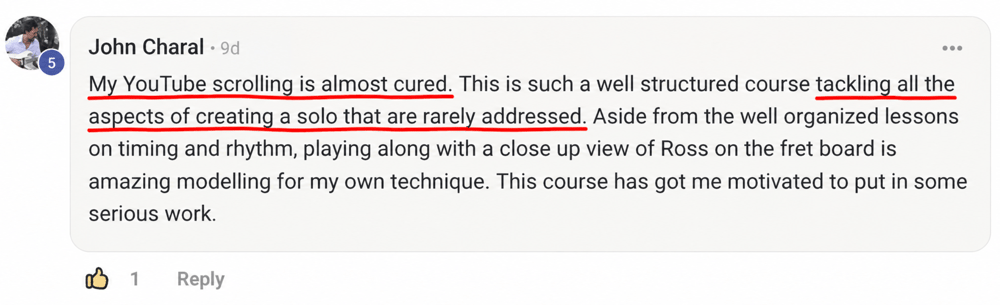
Current student John had this to say: “I learned that I can play faster than I thought I could… just by following the process that you had laid out.”
“Can phrasing really be taught?”
Phrasing is not an unteachable gift called “feel.”
The course breaks it into decisions you can hear and practise: when the phrase begins, which rhythm it uses, how it repeats or develops, where the space belongs and how the complete solo is structured.
As you will see from the solo transformation videos, each one sounds unique. They’ve used the same phrasing frameworks to uncover their own voice on the guitar.
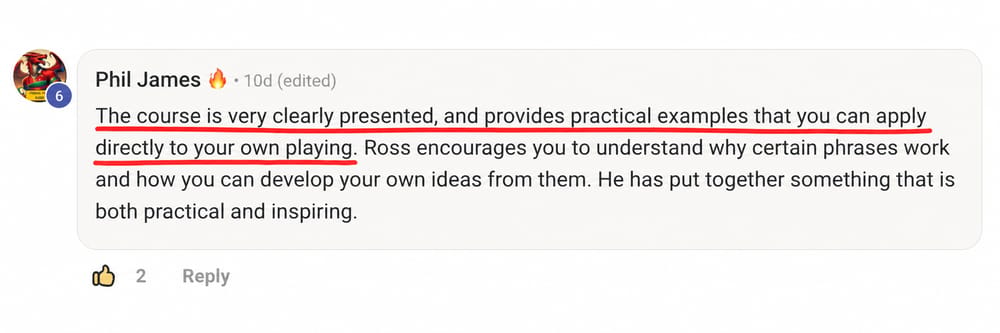
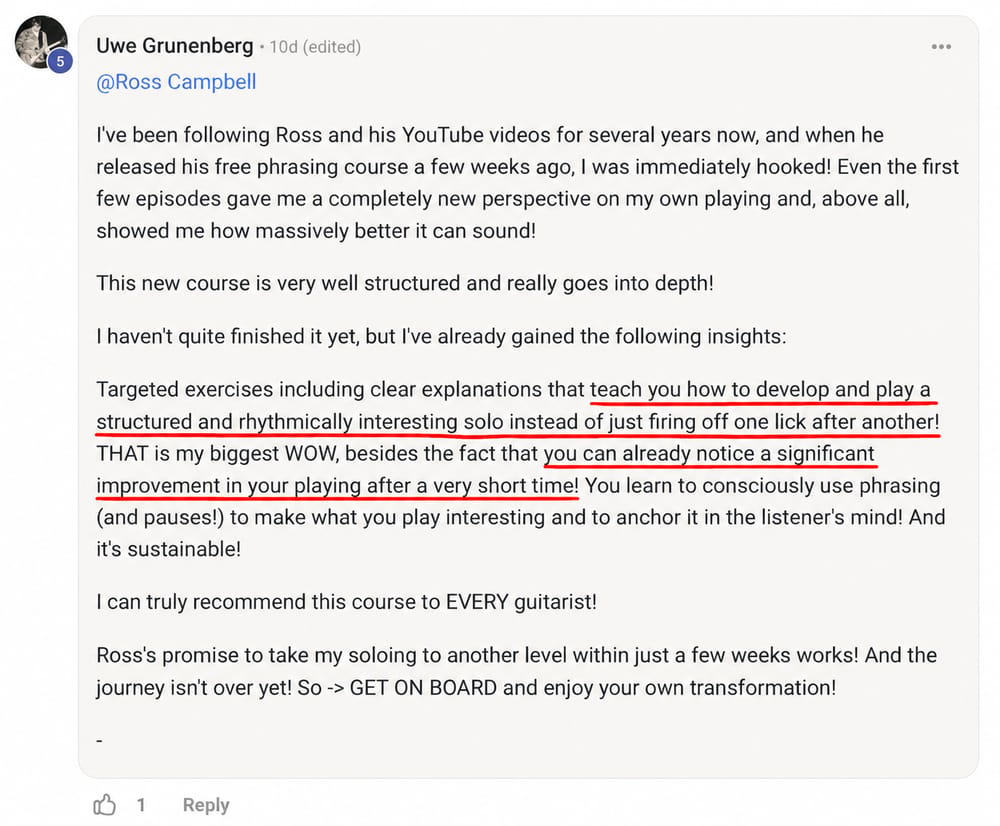
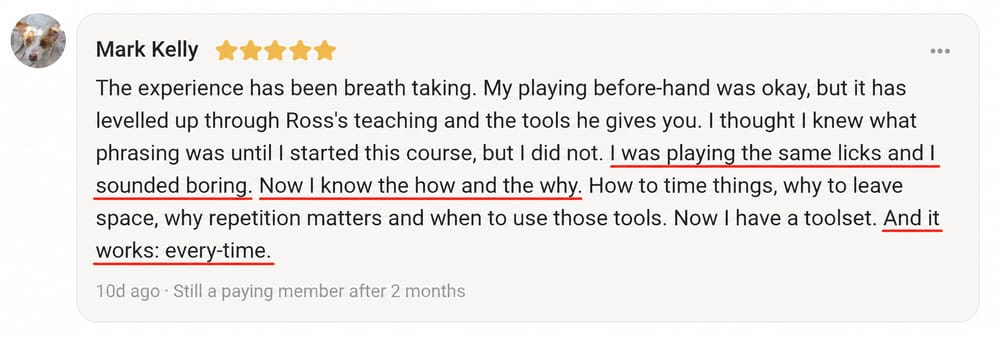
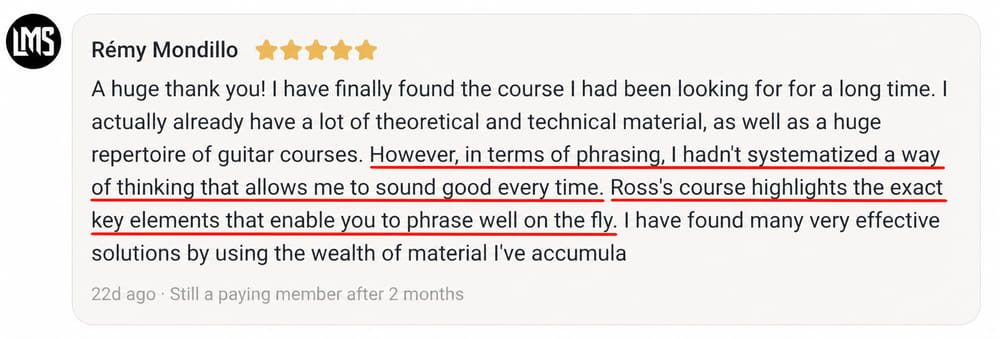
What Current Students Say About
The Art Of Guitar Phrasing
You got questions? I have answers.
The price is $247 USD for lifetime access.
No. You pay once and receive lifetime access to the complete self-paced curriculum.
This is an online course you access through my website - bulletproofguitarplayer.com.
No physical DVDs or CDs are included.
No. This is the standalone Self-Paced Edition of The Art of Guitar Phrasing.
It does not include the community, direct feedback, live calls or coaching provided inside Bulletproof Guitar Club.
I will credit your $167 payment for the self-paced edition of The Art of Guitar Phrasing towards an annual membership at Bulletproof Guitar Club.
The course uses a blues-rock musical foundation, but the core skills - timing, rhythm, repetition, space and structure - can be applied across all styles of lead playing.
The backing track used for all demonstrations is inspired by All Along The Watchtower (the Jimi Hendrix version).
The course is designed for late-beginner to intermediate lead guitarists.
You should be able to play at least a few minor pentatonic positions and know some basic pentatonic licks.
You do not need to know advanced theory, modes or arpeggios.
This is not a course for complete beginners.
Many of the transformations that have come from students of the curriculum were achieved in as little as 33-47 days.
Having said that, it's important to note that your own results may vary and those students benefited from personalised feedback since they used the interactive version of the course inside Bulletproof Guitar Club.
As with anything, consistent practice is the name of the game.
The course contains approximately six hours of video instruction and follows a recommended eight-week learning path.
Because you receive lifetime access, you can move more slowly or revisit any module whenever you like.
Every core exercise is demonstrated at three tempos - 70, 95 and 115 BPM.
Begin at the tempo that feels manageable and increase the speed gradually.
You do not have to be a fast player to develop your phrasing with this course.
Yes. My website is fully integrated with Vidami.
Yes. Downloadable videos are included for every module.
Please note that downloading the content revokes your 30-day money-back guarantee.
Yes, try it out for as long as 30 days and if it's not the right fit for you, send me an email and I'll refund you no questions asked.
*Please note that downloading the lesson videos revokes your 30-day money back guarantee.*
You Already Know Enough Scales. Now Learn How To Turn Them Into Music.
You can keep searching for another scale, another lick or another theory concept and hope that this one finally makes your solos sound musical.
Or you can learn how to control the notes already under your fingers.
The Art of Guitar Phrasing gives you a structured path for developing the five skills most guitarists were never taught: timing, rhythm, repetition, space and structure.
Stop starting every phrase in the same place.
Stop abandoning good ideas after playing them once.
Stop filling every silence because you do not know what should come next.
Start building solos with direction - one connected musical idea at a time.
EVERYTHING INCLUDED WITH YOUR ORDER TODAY:
- Six progressive phrasing modules
- 36 focused exercises and guided workouts
- 16-bar and 32-bar Solo Lab challenges
- Three backing-track tempos
- Guitar Pro and PDF tabs
- Printable practice sheets
- Downloadable videos
- Lifetime access
Get Everything For: $247
Copyright © 2026 bulletproofguitarplayer.com | All Rights Reserved.